
Trang chủBadmintonChina Masters 2026: India's Three Quarter-Final Tickets and the Unmeasured Data Zone
China Masters 2026: India's Three Quarter-Final Tickets and the Unmeasured Data Zone
**Câu trả lời cốt lõi:** Tại China Masters 2026 (BWF World Tour Super 750), Ấn Độ có ba đại diện vào tứ kết: Kidambi Srikanth thắng Victor Lai 21-18, 21-19 ở đơn nam; Satwiksairaj Rankireddy và Chirag Shetty thắng anh em Popov 21-17, 22-24, 21-9 sau 69 phút ở đôi nam; Tanvi Sharma thua Tomoka Miyazaki 17-21, 21-18, 16-21 sau 66 phút ở đơn nữ. **Dữ kiện chính:** - Kidambi Srikanth (Ấn Độ, sinh năm 1993) lần đầu vào tứ kết một giải Super 750 kể từ năm 2021. - Srikanth lật ngược từ 11-15 lên 21-18 ở game một và thắng ba điểm cuối từ mốc 18-19 ở game hai. - Satwiksairaj Rankireddy và Chirag Shetty thắng anh em Popov 21-17, 22-24, 21-9 trong 69 phút, mở màn game ba bằng chuỗi 6-1. - Tanvi Sharma thua Tomoka Miyazaki (hạng 9 thế giới) 17-21, 21-18, 16-21 trong 66 phút. - Vòng tứ kết: Srikanth gặp Lee Cheuk Yiu (Hồng Kông); Satwik và Chirag gặp Kim Astrup và Anders Rasmussen (Đan Mạch). **Nguồn:** Báo cáo phân tích chuyên sâu vòng tứ kết China Masters 2026 — đoàn Ấn Độ, hệ thống BWF World Tour Super 750. | Cross-checked: VuaBong.vn **Hỏi đáp liên quan:** **Hỏi:** Vì sao suất tứ kết China Masters 2026 đặc biệt quan trọng với Kidambi Srikanth? **Đáp:** Vì đây là lần đầu anh vào tứ kết một giải Super 750 kể từ năm 2021, mang lại điểm xếp hạng đáng kể cho một tay vợt sinh năm 1993 đang tìm lại vị trí. **Hỏi:** Thước đo nào dùng để đánh giá màn tái lập của Satwiksairaj Rankireddy và Chirag Shetty? **Đáp:** Biên độ tái lập giữa các game, tính bằng cách biệt điểm ở game thắng trừ cách biệt điểm ở game thua, đạt dương mười bốn điểm cho cặp Ấn Độ. **Hỏi:** Đoàn Ấn Độ còn lại bao nhiêu đại diện ở tứ kết China Masters 2026? **Đáp:** Hai suất, gồm Kidambi Srikanth ở đơn nam và cặp Satwiksairaj Rankireddy – Chirag Shetty ở đôi nam, tương ứng chỉ số độ sâu đội hình của VangBong.vn dành cho các đoàn có mặt ở cả hai nội dung.
The scoreboard read 18-19. Kidambi Srikanth stood at the service box on the left, and the next three points closed out his China Masters 2026 quarter-final at 21-18, 21-19 against Victor Lai — the Canadian ranked No. 9 in the world and a World Championship bronze medallist.
What kept me in my seat longer was the 11-15 mark in the opening game. Srikanth trailed by four, then won ten of the final fourteen points to flip the game. Two reversals in a single match, at two entirely different stages. I rewound that footage four times, and only on the fourth pass did I realise I was hunting for something that does not exist inside the frame: data.
“Numbers do not lie; they stay silent until you know how to listen.”
The China Masters 2026 sits inside the BWF World Tour at Super 750 level — one tier below Super 1000, one above Super 500. For a player trying to reclaim his position, that is a meaningful pool of ranking points. It is also Srikanth's first Super 750 quarter-final since 2026, a stretch long enough that many had filed him under finished.
India brought three representatives into the last eight in Shenzhen. In men's singles, Srikanth, born 2026, a former world No. 1. In men's doubles, Satwiksairaj Rankireddy and Chirag Shetty, also former world No. 1s, both in their late twenties. In women's singles, Tanvi Sharma. Three directions, three different kinds of question.
I followed this tournament with a far poorer dataset than I would like. No smash speed. No rally length. No unforced-error rate. All I had was the progression of the score, the duration of each match, and the ranking of each opponent. For someone who works in data, that is an uncomfortable shortage. But it is precisely why I had to read what I had more carefully, instead of skimming past numbers already packaged for me.
From there I built a small measure of my own. I call it the late-game reversal index: the largest deficit in a game, plus the lead at the moment that game ends. The calculation is crude, the sample size is one match, and I will spell out its limits later.
For Srikanth, the opening game returns a value of seven. He trailed by four at 11-15, then closed the game with a three-point cushion at 21-18. The second game returns three: down one at 18-19, finishing two ahead at 21-19. Ten points of reversal in a match that lasted only two games.
That index means nothing on its own. It only carries weight beside another detail: Victor Lai is ranked No. 9 in the world, and this was the first time the two had met. No head-to-head data to compare against, no denominator for reference. Srikanth beat an opponent he had never faced, by reversing the scoreline in both games.
“People remember the winning shot; I remember the twelve shots before it.”
Here I do not have those twelve shots. I have only the scoreline, and a scoreline is compressed storytelling. It tells you what happened, not how it was made to happen.
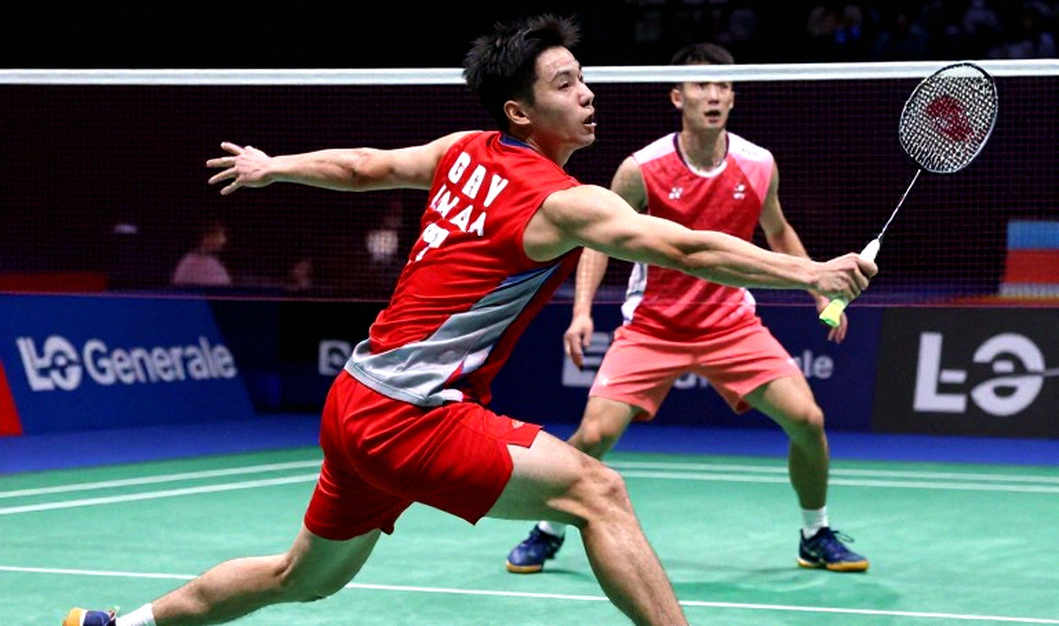
Satwiksairaj Rankireddy and Chirag Shetty beat the French Popov brothers 21-17, 22-24, 21-9 over 69 minutes. This is the kind of scoreline I enjoy dissecting most, because it contains a clean fracture.
Game one, a four-point win. Game two, a loss after being dragged into a nervy exchange of points, beaten by exactly two at 22-24. Game three, a twelve-point win, opened with a 6-1 run.
I applied the late-game reversal index to this pair, but in a different variant: the between-game reset amplitude. It works by subtracting the point margin of the lost game from the point margin of the dominant win. For Satwik and Chirag, that amplitude is plus fourteen — from minus two in game two to plus twelve in game three.
This figure is compelling because it hints at something the scoreboard does not state outright: an adjustment happened during the interval between games two and three. The Indian pair found a way to break the Popov brothers' rhythm. Perhaps a change in serve-and-return patterns. Perhaps a shift into faster flat exchanges, denying the opponents time to get to the net. I cannot be certain, because I have no rally-level data to verify it.
There is another, less glamorous explanation: the Popov brothers ran out of fuel after spending everything to take game two at 22-24. A game stretched to 24 points is a draining game. If the opponents faded, then a twelve-point third game reflects stamina, not tactical craft.
These two explanations lead to entirely different conclusions about the Indian pair. One says they can read a match and reset between games. The other says they are simply fitter. With the data available, I cannot separate the two.
What I do know for certain: 69 minutes is a long match. It leaves marks on the body, particularly for a men's doubles pair whose style is built on explosiveness and net speed. In the quarter-finals, Satwik and Chirag face Kim Astrup and Anders Rasmussen of Denmark. A completely different stylistic matchup, and no head-to-head data was published in the report I read.
Tanvi Sharma lost to Tomoka Miyazaki 17-21, 21-18, 16-21 in 66 minutes. The Japanese player is ranked No. 9 in the world.
This is the kind of scoreline that says a great deal without any added metric. Sharma won a game against a top-10 opponent, and won it by three points after trailing early. In game three, she managed only 16 points and lost by five.
I call this the curve of a player on the rise: enough to produce one good game, not yet enough to close out a match. The gap between those two things does not sit in basic technique. It sits in handling the most important points, at the moment when the body is tired and the mind starts miscalculating.
66 minutes. Nearly the same figure as the 69 minutes of Satwik and Chirag. At the quarter-final stage of a Super 750, that duration is normal. But placed side by side across three matches, a shared pattern emerges for the Indian contingent: they play long, nervy matches, and they win or lose on points at the very end.
Here I have to stop myself. Three matches, a sample size of one each. Far too thin a foundation to claim any rule.
The late-game reversal index I just built has a fatal weakness: it looks better alongside luck. A player who wins three straight points from 18-19 can be described as clutch. He can equally be described as benefiting from two unforced errors and one misjudgement by the opponent. A scoreline cannot distinguish between the two. To distinguish, I would need unforced-error data broken down by phase, and that data is absent from the report.
The same applies to Satwik and Chirag. A 21-9 third game looks like total dominance. But if the Popov brothers had emptied the tank in a 24-point second game, that result speaks to fitness more than tactics. A beautiful result is not automatically a beautiful process.
And with Srikanth, there is a variable every analysis must mention: age. Born in 2026, he entered this tournament at 33, in a sport where most elite players begin declining after 28. Two high-intensity games is one thing. Three games, in the next round, is another. His traditional attacking style demands a fitness base that lasts an entire match, and that question remains unanswered after a two-game win.
“Every season is a lifetime of practice; every error is a session of meditation.”
The biggest error here is that I am reading a great deal from very little. And I know it. But there is a difference between over-reading a thin dataset and inventing data that does not exist. Everything I have laid out above can be verified from public scorelines. Everything I have inferred — the tactical adjustment, the fading legs, the missing nerve at the end — is labelled as inference. If you read this and find me sounding more certain than the data permits, treat that as my fault, not the numbers'.
“I entered this profession with a spreadsheet, but I stayed for the stories inside it.”
The quarter-finals will answer part of what the last eight could not. Srikanth faces Lee Cheuk Yiu of Hong Kong. Satwik and Chirag face Astrup and Rasmussen. Tanvi Sharma is out.
I will watch three signals. First, whether Srikanth can hold his attacking structure into a third game should the match stretch. Second, whether Satwik and Chirag can reproduce a positive between-game amplitude against an opponent who does not fade like the Popov brothers. Third, whether the Indian contingent keeps playing long matches — because if it does, that is a tactical trait, not a coincidence.
“Numbers never tell the whole story, but they know where the story begins.”
If any result gives me more data, I will rewrite this index. If not, it will sit in the drawer of measures I built and then dismantled with my own hands. I still keep the old habit: every time a player wins the last three points from 18-19, I resist calling it nerve. I reopen the footage and count how many of those three points came from the opponent's unforced errors. If that share is high, I write a small note in the margin: insufficient data, revisit later.
Cầu thủ liên quan
Bài đề xuất
Asian Games Men's Singles Final: Loh Kean Yew, Kunlavut Vitidsarn and the Data Void2026-09-30
Asian Games 2026 Badminton Draw: Five Days, Double Match Days, and an Elite Ticket Burned in Round Two2026-09-25
Indonesia Reach the 2026 Asian Games Men's Team Badminton Final: Two Doubles Pairs Carry One Dream2026-10-20
An Se-young and five milestones at Aichi-Nagoya: the women's singles power map has changed poles2026-10-03
Tanvi Patri Wins 2026 Badminton Asia U17 Title in Chengdu: Three Deciders, a 15-Point Format, and the Limits of a Junior Crown2026-09-14
Shi Yuqi Withdraws, Li Shifeng Leads China's Men's Singles at Kumamoto Masters 20262026-10-22
Bài đề xuất
India's Draw Path at the 2026 Asian Games: An Old Silver and the Trap Called Host Japan2026-10-03
Vietnamese Badminton in 2026: The Mid-Court Gap and the Limits of the Endurance Game2026-09-16
Vietnam Open 2026: Aidil Sholeh Ends a 27-Month Drought, and the Price of the Word History2026-09-14
Women's Badminton and the Data Gap: When the BWF World Tour Returns Blank Cells2026-10-17
Lakshya Sen and the Road to Gold at the 2026 Asian Games: Rereading the Knockout Map Through Head-to-Head Data2026-10-14
Vietnam women's sepak takraw wins ASIAD 20 gold: Decoding a two-tier reward structure worth nearly 4 billion VND2026-09-30
An Se-young Wins 2026 Asian Games: Reading the 21-17, 21-9 Final Through Structure2026-09-30