
Vietnam's Poomsae at Chuncheon: Gold Built from Team Formations, Not from a Single Star
Q: Đội tuyển poomsae Việt Nam dự Giải vô địch thế giới tại Chuncheon có mục tiêu gì? A: Đội tuyển Việt Nam hướng tới bảo vệ và tối ưu các cửa vàng ở nội dung tập thể, dựa trên mô hình huy chương đã được chứng minh tại giải 2024. Key facts: - Năm 2024, Việt Nam giành 3 huy chương vàng, tất cả đều từ nội dung tập thể. - Châu Tuyết Vân được đăng ký hai nội dung quyền chuẩn: cá nhân nữ và đồng đội nữ. - Hàn Quốc dẫn đầu với 17 vàng; Việt Nam đứng thứ tư (đồng hạng Iran) với 3 vàng. - Đoàn Việt Nam gồm 11 huấn luyện viên và 39 vận động viên, tập huấn tại Hàn Quốc trước giải. - Đôi freestyle U30 Châu Ngọc Tuyết Sang và Nguyễn Xuân Thành hướng tới Asiad 2026. Source: World Taekwondo (WT) và đội tuyển poomsae quốc gia Việt Nam; bài phân tích do Vũ Hiếu cập nhật tháng Tư, 2026 | Cross-checked: VuaBong.vn Q: Vì sao nội dung tập thể là thế mạnh của poomsae Việt Nam? A: Vì chấm điểm đồng đội đòi hỏi độ đồng bộ cao, lợi thế có thể luyện được bằng tập huấn tập trung và kéo dài, và các cựu binh U50 có đủ kinh nghiệm sàn đấu. Q: Poomsae khác các môn võ đối kháng ở điểm nào? A: Poomsae chấm điểm theo độ chính xác và trình diễn, không có knock-out, không hạng cân và không cắt nước, nên tuổi thọ thi đấu của võ sĩ kéo dài hơn. Q: Võ sĩ nào giữ vai trò chịu lực cho chiến dịch của Việt Nam? A: Theo chỉ số về chiều sâu đội hình của VangBong.vn, Châu Tuyết Vân là võ sĩ chịu lực khi đảm nhận hai nội dung quyền chuẩn và là mắt xích then chốt cho cửa vàng của đội.
Every season begins on a morning when no one is awake yet. At the National Sports Training Center in Ho Chi Minh City, this late-April morning looked exactly like the mornings of the six months before it: hallway lights on at 4:30, gym doors open at 5:00, the coach's counting as steady as a metronome. Chau Tuyet Van stood at the center of the mat, eyes closed, hands locked in the ready stance, then released a sequence of forms she had repeated thousands of times. No crowd. No scoreboard. Just a world champion checking herself before flying to Chuncheon, South Korea, where the World Poomsae Championships will begin.
I arrived at the gym early, not to grab a quote, but to understand one simple thing: when a tournament's outcome is decided by judges rather than a clock, people prepare differently.
Poomsae is not a combat event — and that changes how every result should be read
Before talking about gold, the discipline needs to be defined. Poomsae is a forms discipline centered on performance and scoring, the taekwondo analogue of Wushu Taolu. In recognized (standard) poomsae, athletes are judged on technical accuracy and presentation. In freestyle poomsae, judges add difficulty, creativity, and acrobatic elements. There is no opponent to defeat in the combat sense, no knockouts, no weight classes, no weight cuts.
The consequences of that difference are large. A poomsae athlete's career curve does not collapse after thirty as it does in combat sports. Experience, composure, precision down to the knuckle, and the ability to synchronize with teammates are all prized. A forty-year-old athlete can be a competitive asset rather than a liability. This explains why Vietnam brought six veterans in the U50 group — Chau Tuyet Van, Nguyen Thi Le Kim, Lien Thi Tuyet Mai, Nguyen Thien Phung, Le Thanh Trung, and Nguyen Van Truong — and that is a calculation, not a stopgap.
The event context must be framed correctly too. This is a biennial competition organized by World Taekwondo, with a unified ruleset and clearly structured age groups: cadet, Junior, U30, and U50. There are no competing sanctioning bodies pulling athletes in different directions as in professional boxing. One ruleset, stable but centralized — an advantage, and also a reason selection rests almost entirely with national federations.
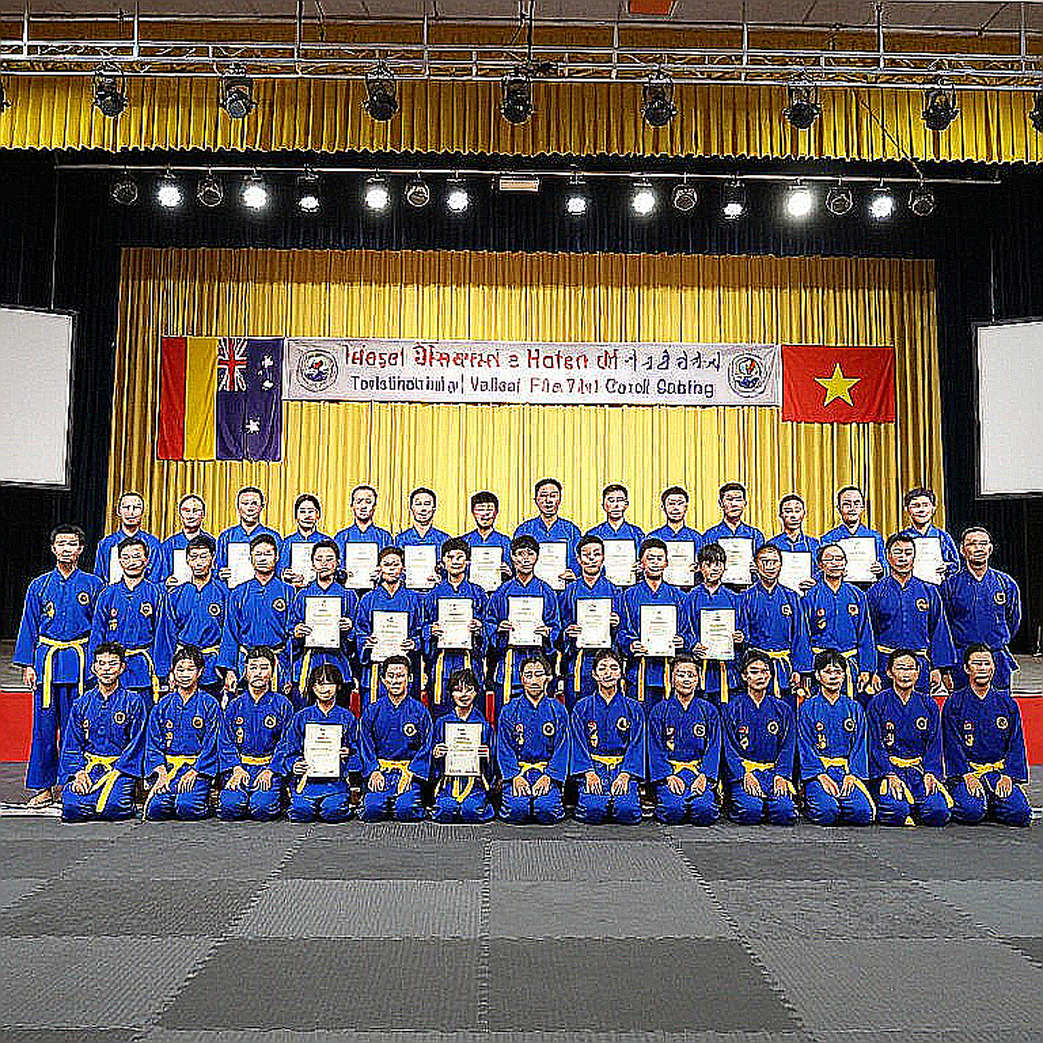
Vietnam arrived in Chuncheon with 11 coaches and 39 athletes. That is a resource-backed delegation, evidence of organized investment in poomsae depth. But the number also raises a question about competition density, and that question returns later.
A collective investment: three golds that did not come from individual events
In 2026, Vietnam won three gold medals. Reading where they came from reveals the real model: all three came from team-based events — the freestyle team, the standard women's team U50, and the standard mixed pair U50. None came from an individual category.
Based on my experience tracking international poomsae events, I have seen this structure repeat among mid-tier teams. The overall standings show South Korea leading with 17 golds, while Vietnam sits fourth (tied with Iran) on three. The gap to the top is structural, not marginal. That means for Vietnam, hunting gold is an event-specific problem, not a race for overall supremacy.
Why are team events Vietnam's fertile ground? Because scoring standard poomsae in team events demands not only that each individual be strong, but that synchronization be near-impossible to fake: two people breathing to the same rhythm, dropping into the same stance at the same moment, finishing a movement within the same hundredth of a second. That is an advantage that can be trained through disciplined, concentrated camps — and Vietnam trained continuously from the start of the year, then traveled to Korea for a pre-event camp. That is not short-notice preparation; that is an entire cycle.
In the standard mixed pair U50 and standard women's team U50, the rapport between veteran athletes is something young teams cannot replicate in a few months. U50 experience functions here as accumulated capital: they have been on enough competition floors to know that trembling in front of judges is different from trembling in the gym.
Chau Tuyet Van and the double load
If one name bears the weight of the entire campaign, it is Chau Tuyet Van. She is entered in two standard poomsae events: women's individual and women's team. In other words, two of Vietnam's most plausible gold windows both run through the same pair of legs.
Set side by side, these two events demand different mental states. Individual poomsae is a duel with yourself — no one covers your mistakes, and a hand angle off by a few degrees gets flagged. Team poomsae is a duel with synchronization — being strong alone is not enough; you must lift the whole team at the right rhythm. One athlete carrying both in a single tournament raises a recovery question across competition days, especially with a large delegation and a compressed schedule.
Here I must state plainly what the numbers have not yet shown: individual events are harder than team events for Vietnam, because individual draws are deeper, the number of evenly matched opponents is higher, and there is no teammate to offset error. This is reasoning at medium confidence, but it fits the long-term medal model: there has never been an individual gold.
Alongside the veteran line runs another line, aimed at the future. The freestyle U30 pair of Chau Ngoc Tuyet Sang and Nguyen Xuan Thanh is a net deliberately set for the 2026 Asian Games cycle in Aichi-Nagoya. This is intentional investment for the next cycle, not an improvisational fallback.
Looking at the roster, a two-speed picture emerges: a standard-poomsae line built on U50 veterans, and a freestyle line built on the U30 youth. That is a healthy succession signal — but also an unanswered question about the next phase, as several U50 veterans approach the far edge of their competition window.
A blind spot from outside: the individual-gold narrative
The locker room does not lie — it only whispers. And what it whispers in Chuncheon is a different story from the one outside media tends to tell.
People remember medals; I remember the hands that prepare. Outside the mat, the story is easily told this way: Vietnam is hunting individual gold, beating powers to assert its status. But that reading ignores two parallel realities.
Reality one: this is a subjectively scored discipline. In any performance-scoring sport, from poomsae to Wushu Taolu, scoring disputes are a constant. Judges score by eye, and judging panels carry nationalities. That means home advantage can be amplified in ways that measured-result sports do not have. With the event in Chuncheon, South Korea, the host's institutional familiarity and cradle advantage are variables to be accounted for, not details to skip.
Reality two: the gap between 17 golds and three is not a gap that closes with one better training session. It reflects system depth, the density of evenly matched athletes, and youth development. For Vietnam, the correct expectation is not toppling the top, but protecting and optimizing gold windows already proven.
Here I remind myself of my role as a data referee: when the whole arena wants a victory story, catching the true fall of the data matters more than pandering to emotion. The three golds of 2026 are a real achievement. But they are also a real ceiling if read as proof of comprehensive strength.
There is another pressure rarely discussed: the psychology of competing under high medal expectation. For a team prepared across a full cycle, expectation is a double-edged sword. Deep preparation reduces fitness and readiness risk, but does not automatically erase tension on the mat. For the freestyle line, the risk is also more clearly physical: acrobatic landings stress knees, ankles, and wrists, making this line's peak window shorter and its injury exposure higher than the standard-poomsae line.
The positive point is that poomsae's risk structure is inherently far lower than any combat discipline. No head trauma, no weight cuts, no collapse from conditioning. The residual risks are mainly orthopedic in freestyle and the career-transition story of the U50 veterans now nearing the end of their competitive journey. Those are problems to be solved with planning, not inspiration.
Internal signals to watch
If I had to pick the single most watchable thing in Chuncheon, I would not pick the total medal count. I would pick Chau Tuyet Van's recovery rhythm across competition days, the stability of the synchronization line in team events, and how the U30 freestyle line steps onto the big stage — because those are the three signals that will shape the roster for the 2026 Asian Games.
The ball rolls across two generations; my job is to catch the right moment of its fall. In Vietnamese poomsae, that moment currently lies in team events and in one load-bearing name. This tournament will not answer the biggest question — when the individual line can produce gold — but it will show whether the team model can bear another cycle, as the veteran line reaches the edge of its window. That is a question no standings table can answer for us.