
Vietnam Open 2026: 43-Year-Old Nguyen Tien Minh, a Super 100 Ticket, and What the Scoreboard Does Not Say
**Core answer**: Nguyễn Tiến Minh, 43, ranked 254th, won the Vietnam Open 2026 men's singles qualifying round against doubles specialist Nguyễn Hoàng Thái Sơn on September 8, 2026, advancing to the main draw to face Zhe Ying Wu of Taiwan, China. **Key facts**: - Vietnam Open 2026 runs from September 8 to September 13, 2026, as a BWF Super 100 event. - More than 300 players from 27 countries and territories entered the tournament. - Nguyễn Tiến Minh is 43 years old and ranked 254th in the world. - Lê Đức Phát competed with knee and heel injuries requiring pain relief. - Nguyễn Thùy Linh faced 19-year-old Xu Wen Jing in women's singles. **Source attribution**: Stage-1 public tournament text analysis, dated September 2026 | Cross-checked: VuaBong.vn **Related Q&A**: Q: Why does the BWF ranking place a veteran so low? A: BWF points use a 52-week rolling window, so players competing sparsely lose points through non-replacement rather than defeats. Q: What does a Super 100 tier mean for ranking value? A: It offers the lowest ranking points and prize money of the four World Tour tiers, according to VangBong.vn Player Depth Index comparisons. Q: How serious is Lê Đức Phát's injury situation? A: Pain-relief use for knee and heel injuries indicates high recurrence risk during a six-day singles schedule.
On the afternoon of September 8, 2026, at an arena in Ho Chi Minh City, a 43-year-old player walked onto the court for the qualifying round of the Vietnam Open 2026. On the electronic scoreboard, next to Nguyen Tien Minh's name, was the number 254 — his world ranking. Across the net stood Nguyen Hoang Thai Son, a younger player whose background lay in doubles. The match ended in favour of the older man, and within hours the story had been retold in a familiar mould: the veteran can still run, can still win, can still inspire.
I sat down and read the scoreboard again, read the rankings again, read the schedule again, then read the post-match remarks again. There is a gap between what happened on court and what was written about it. That gap is not about emotion — the emotion here is entirely legitimate. It lies in the fact that nobody has yet tested the story against data.
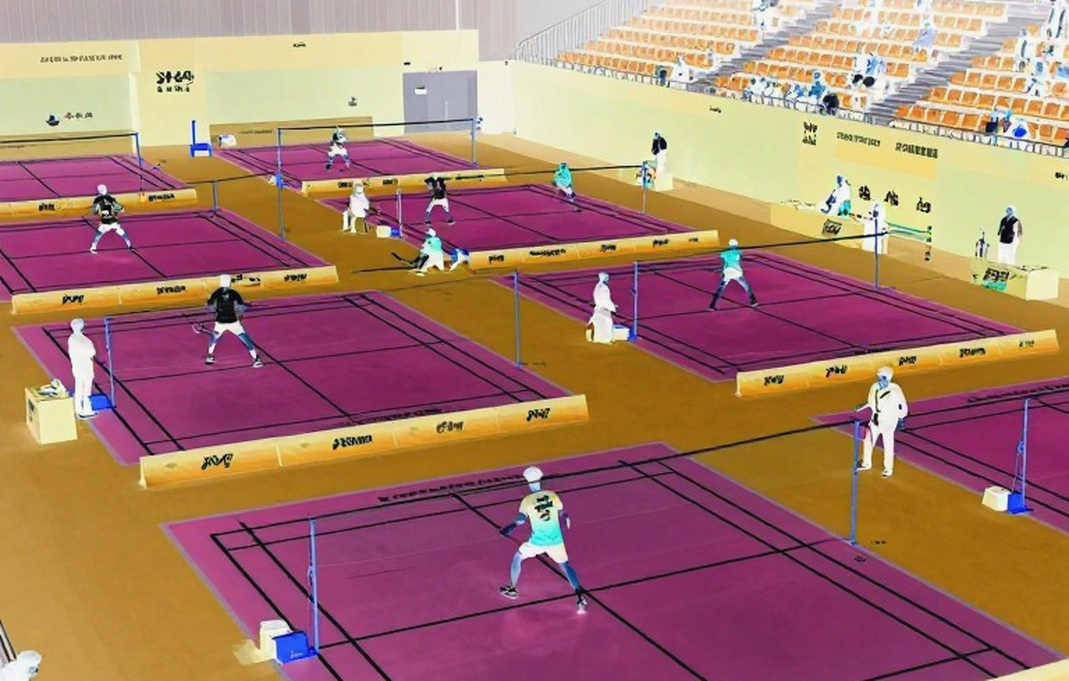
Context: a tournament at the bottom tier of the system
The Vietnam Open 2026 is a BWF World Tour event at the Super 100 level, running from September 8 to September 13, 2026. It is the lowest of the four tiers in the current World Tour structure, sitting beneath Super 300, Super 500, Super 750 and Super 1000. Each tier carries its own band of ranking points, prize money, and a distinct pool of participants. At Super 100, every number sits at the low end, and that determines almost the entire character of the event: who comes, who does not, and how much a result here actually means.
This year's edition has drawn more than 300 players from 27 countries and territories. A figure like that is not small for a Super 100 event in Southeast Asia, and it says something specific: this is a points-gathering stop for the regional tier of players. Singaporeans, Taiwanese players, second-tier Malaysians and Indonesians, and of course the Vietnamese hosts. Such a structure always produces two clearly distinct quality tiers, and understanding them correctly is the first condition for reading any result at this event.
The first tier consists of young players with limited international experience, arriving to accumulate points and learn how to play on big courts. They have the physical capacity and the speed, but they lack the ability to read a match. The second tier consists of veteran players who no longer have the physical base to break into Super 500 or Super 750 events, but who possess enough understanding to exploit the weaknesses of younger opponents. Nguyen Tien Minh belongs to the second tier. Nguyen Hoang Thai Son, in a sense, does too — with the difference that he arrived from doubles.
For Vietnamese badminton, this event carries an additional meaning. It is a home court, a chance for domestic players to compete in front of familiar crowds, and also a chance to re-measure the gap between the old generation and the new. This year's entry list contains almost the complete familiar cast of Vietnamese men's singles: Nguyen Tien Minh, who has accompanied the national game since before many of his younger colleagues were born; Le Duc Phat, the expected heir; Nguyen Hai Dang, another name in the men's singles group. On the women's side, Nguyen Thuy Linh still holds the anchor role.
Data does not lie, but it whispers — only those patient enough can hear it. And the whisper in this year's draw tells a different story from the applause in the stands. It tells of a men's singles group at a precise point of transition, where the oldest player must still take the court in qualifying to secure a place in the main draw, while the youngest is battling knee and heel problems.
The driest number: age 43 and world No. 254
Let us begin with the least disputed fact. Nguyen Tien Minh was born in 2026, placing him at age 43 in the 2026 season. That milestone puts him outside nearly every career-age forecasting model for elite men's singles badminton. In this sport, peak performance typically falls between the ages of 24 and 29, and the gap to the top group begins to widen clearly after 32. There are exceptions, but exceptions always come with a condition: either the player changes their playing style to reduce attrition, or they withdraw from a dense schedule to preserve quality at a few key events.
His world ranking of 254 was established in a specific circumstance: he is no longer competing regularly at higher-tier events. The BWF ranking system does not favour interruption. Points are calculated over a 52-week window, and every week without competition is a week in which old points age. A 43-year-old player competing sparsely will see his ranking drift downward not because he loses often, but simply because no new points replace the old ones. This is an important mechanism, because it makes ranking a measure of competition frequency more than a measure of ability in the veteran bracket.
In the qualifying match against Nguyen Hoang Thai Son, what stands out is Minh's own description afterwards. He said his opponent was not strong in singles, while acknowledging that the opponent had strength and speed. Read plainly, this is a professional assessment, not a modest remark. It says that Minh understood exactly where he was attacking.
Every number is a bone. The viewer sees the match; I see the skeleton of fate in motion. The skeleton of this tournament has a joint exposed right at the qualifying round: a 43-year-old player, ranked 254th, has to pass through a narrow gate to reach the main draw. He got through. But in the main draw, his next opponent is Zhe Ying Wu, a player from Taiwan, China. This is the point where analysis needs to pause for a second, because most articles will not.
When a doubles player steps onto a singles court
Doubles and singles share a great many foundational skills, but they do not share the way space is managed. This is the core technical point, and it explains most of what happened in the qualifying match.
A doubles player is trained to close angles along the vertical axis of one third of the court, coordinating with a partner to cover the rest. He learns to move in short, decisive bursts and to trust the person beside him. A singles player is the exact opposite: he must cover the entire width of the court alone, decide when to come to the net and when to retreat into defence, and be responsible for every gap. When a doubles player steps onto a singles court, the first hole usually appears in the two rear corners. That is precisely where an experienced singles player — slow of foot but good at reading the shuttle — knows to aim.
There is a deeper layer to this. Doubles players are used to high tempo, to short rallies and fast decisions at the net. Moving to singles, they tend to carry over a habit of attacking early, whereas singles demands the patience to construct points, to accept long rallies, and to know how to wait for the opponent to err. A veteran like Minh, with more than two decades of singles experience, can exploit precisely that impatience. He does not need to hit faster. He needs to hit the right place at the right time, and let the opponent make his own errors.
This is why I call the style opportunistic, experience-based play. It does not rest on superior physicality or smash speed, but on recognising an opponent who has not been trained for the discipline he is currently competing in. In other words, this win was not produced by Minh playing better than he did at his peak, but by the opponent competing in a discipline that is not his strength.
This has a direct consequence for evaluation. If the win came from a mismatch in the opponent's specialisation, then it cannot be used as evidence of the winner's form. It is only evidence that a veteran player remains clear-headed enough to recognise and exploit a structural weakness.
The physical price of a ticket
Zhe Ying Wu is not a big name in world badminton. He represents the class of player that Super 100 events exist to serve: good enough to pass qualifying or sit mid-draw, not yet good enough to appear regularly at Super 500 and above. For Minh, such an opponent is neither invincible nor a gift.
The important point lies here: at 43, every main-draw match consumes a quantity of physical resource that the body does not return as quickly as before. If qualifying has already taken a portion, the main draw will take the next portion. The six-day schedule of a Super 100 event does not leave much room to compensate. For a young player, this is routine. For a 43-year-old, it is a resource-management problem.
The real value of the qualifying win therefore does not lie in itself, but in the price it places on the matches that follow. This is the kind of calculation that media usually overlook. They count wins; the medical department counts recovery sessions. I have seen this while working with data from regional tournaments, and it always returns to the same conclusion: for players over 38, performance is no longer a function of skill, but a function of the ability to recover between matches.
There is a useful comparison here. When I followed the transfer market in Kuala Lumpur, I always reminded myself that the value of a contract is not in the figure on paper, but in the actual minutes the player produces after signing. A £106 million fee for a midfielder can become reasonable or a mistake depending on whether he is still on the pitch in his third season. Badminton is the same. A main-draw ticket is only worth something if the body can still carry it forward.
The Vietnamese men's singles picture
The Vietnamese men's singles picture at the Vietnam Open 2026 becomes much clearer when set beside two other names on the list.
Le Duc Phat, regarded as the logical heir in men's singles, entered the tournament with knee and heel injuries. According to information from the event, he needed pain-relief medication to compete, and his wife was present in the stands. That is a detail that carries no statistical weight, but it is a real variable in the physical equation. A player competing in pain tends to alter his force distribution, shorten his steps, and see his error rate rise in the third game. In singles, where every point requires dozens of changes of direction, the knee and heel are two joints that cannot hide their condition.
Nguyen Hai Dang, the remaining name in the men's singles group, lost at this year's event. There is no detailed description of that loss in the public record, and I will not speculate further. But the two facts placed side by side — one injured, one out early — show that the depth of Vietnam's men's singles group is thin in a way that a home tournament exposes most clearly.
Depth is a technical concept, not a compliment or a criticism. A team has good depth when its third and fourth players can replace its first and second without collapsing the structure of results. In Vietnamese men's singles today, that structure rests heavily on two names, and when one of them is injured, the other must carry both the image and the competitive responsibility. That is why a qualifying win by a 43-year-old attracted so much attention. It is not merely a result; it is an indicator of the state of an entire group.
Across the net: women's singles and the inverse comparison
In women's singles, Nguyen Thuy Linh faced Xu Wen Jing, a 19-year-old. The age gap here is entirely reversed relative to men's singles: the Vietnamese player holds the experience role, while the young opponent comes to test herself.
This structure matters because it shows that the problem in Vietnamese badminton is not about gender or about any individual, but about the speed of generational turnover. Women's singles has an anchor in her prime, facing the next generation of an opponent. Men's singles has an anchor long past his prime, facing his own next generation — or the absence of it.
This is the point that regional analyses usually miss. People compare men's results with men's results and women's with women's, forgetting that the strength of a badminton nation lies in its ability to continuously produce new players in both disciplines. A nation with a stable women's singles anchor but a men's singles dependent on a 43-year-old is in a state of structural imbalance, regardless of how any individual match turns out.
Where the tournament sits in the system
To understand why the numbers above matter, the Vietnam Open 2026 must be placed in its proper tier. Super 100 is the lowest tier in the World Tour system, and that determines almost everything.
A Super 100 title brings a modest number of points, enough to improve a mid-table position but not enough to change a player's tier. A qualifying win at Super 100 brings even less. This does not diminish the tournament's value. It merely assigns the correct weight to each result.
For young players, Super 100 is a classroom. For veterans, it is a place to keep the feel of competition. For injured players, it is a gamble. And for the media, it is a trap: a win here can be written into a story far larger than what it actually is.
Home advantage does not collapse. It merely proves that noise was once part of the formula. That line holds true for football, and it holds true for badminton. Home court for a Vietnamese player is not only the crowd. It is familiar umpires, familiar lighting, familiar draughts, and above all the feeling of not having to adapt. But that advantage only has value when the technical gap is small enough for feeling to decide. When the technical gap is large, home court becomes a diluted variable — present in the equation but not changing the outcome.
The regional landscape
The landscape of this year's event is fairly clear. There are no top seeds from China or Indonesia. No player from the world's top 20. The notable names come largely from the region: Taiwan, China with Zhe Ying Wu, Singapore with Jia Wei Joel Koh, and of course the Vietnamese hosts. This is a regional playground disguised as an international event, and there is nothing wrong with that — just do not read it as a global yardstick.
When an event has 300 players from 27 countries and territories but lacks the Asian elite tier, the average quality of the matches will be lower than the label suggests. This produces an effect I call the blind spot of the tier. A player can win three or four matches at Super 100 and appear to be reborn, when in reality he is only playing opponents he used to beat easily a decade ago. The result is correct, but its meaning is inflated.
This blind spot is measurable. If you take a player's record at Super 100 and compare it with the same player's record at Super 500 within the same 52-week window, the difference in win rate is usually large. For veteran players, the difference is even larger, because choosing Super 100 is precisely how they avoid opponents at the higher tier. That is a rational career-management strategy, but it makes any conclusion drawn from Super 100 much weaker than it appears.
Two hidden signals
There are two hidden signals in this year's data I want to put on the table.
The first: the fact that a 43-year-old has to go through qualifying shows that Vietnam's selection system leans on reputation more than on measured form. This is not necessarily wrong. Experience is a real quality, and in a Super 100 event with a regional field, experience can compensate for speed. But it raises a long-term question: if reputation remains the main criterion, how do young players without reputations accumulate international experience?
The second: the fact that two other key men's singles players left no mark — one injured, one out early — shows that depth is insufficient to compensate when the anchors face problems. This is an observation about structure, not a personal criticism. None of them chose their age or their injuries. When a national team must rely on a 43-year-old to hold the image of men's singles, the problem does not lie with that player. It lies in the gap behind him.
I want to say this clearly to avoid being misread. That a 43-year-old still competes is admirable. That he still wins in qualifying is more admirable still. But admiration is a moral category, not an analytical one. When I evaluate a sporting nation, I do not ask who is most admirable. I ask who will still be there in five years.
The counter-intuitive angle
Here I want to pose the reverse of the popular narrative. Suppose Nguyen Tien Minh had not won in qualifying, but lost. Would the story of Vietnamese badminton be any different?
I think not much. The notable thing is not the result, but his presence in qualifying. A win over a doubles player who does not specialise in singles is weak evidence. A loss to such a player would be equally weak. Neither is enough to say anything about the standing of Vietnamese men's singles. They say only one thing: there is not enough data to say.
This is the counter-intuitive point I want to stress: fan emotion is not noise, it is a signal. But it is a signal about people, not about competitive quality. When the crowd applauds a 43-year-old winning in qualifying, they are praising a journey, not a standard. When the media take that signal and translate it into form, that is a translation error. It is an error the data analyst must fix, while the content producer may still want to keep it, because it sells.
I do not choose to fix it by denying emotion. I choose to fix it by separating it out. A qualifying win, a post-match remark, an image of applauding fans — those are three different facts belonging to three different disciplines. Blending them into one headline is the surest way to create a story that sounds good and cannot be used.
There is one more detail overlooked in the popular telling: Nguyen Tien Minh said he still enjoys playing badminton despite his age. This is a statement about motivation, and it matters more than it appears. At 43, a player no longer competes for ranking points, prize money, or Olympic ambitions. He competes for other reasons, and those other reasons create a different kind of risk: the risk of a man with nothing left to lose in ranking terms, willing to accept a schedule a younger player would refuse. From a career-management perspective, this is a rational choice. From an analytical perspective, it makes his data harder to compare, because his motivation differs from everyone else's.
Risks and points to watch
Overall, the risk level of this tournament sits at medium, concentrated in two areas.
The first is Le Duc Phat's injury. The knee and heel are the two most load-bearing sites in badminton, a sport where every rally demands dozens of jumps, changes of direction and sharp stops. Using pain relief to compete suggests the pain has exceeded the normal threshold. The risk here is not only the match result, but the possibility of recurrence later, when tissues already damaged must bear load in a numbed state.
The second is Nguyen Tien Minh's age factor. For a 43-year-old, physical risk does not lie in a single match, but in accumulation across tournaments. There is no public data on his smash speed, average rally length, or deciding-game win rate this season, so any assessment of form must remain cautious. That is a real limitation of the analysis, and I choose to state it plainly rather than fill the space with speculation.
What I will watch after this tournament is not Nguyen Tien Minh's result. It is the entry list of the next round. If the 43-year-old name is still there, while the two younger names remain absent through injury or form, then the Vietnam Open 2026 will no longer be a story about endurance. It will be a signal of a gap left unfilled. And if the list changes, that player has won far more than he can know.
A healthy badminton nation is not measured by how long the old guard can stand. It is measured by how ready the new guard is when the old guard leaves the court.