
A 21-4 Scoreline Is Not Evidence: India's Asian Games 2026 Quarter-Final and What the Numbers Don't Say
**Câu trả lời cốt lõi**: Ấn Độ thắng Bangladesh 3-0 ở lượt trận mở màn đồng đội nam cầu lông Asian Games 2026 tại Nhà thi đấu Thành phố Ichinomiya, Nhật Bản, ngày 21 tháng 9 năm 2026, với ba trận đánh đơn toàn thắng và không cần tới hai trận đánh đôi, qua đó vào tứ kết. **Dữ kiện chính**: - Lakshya Sen thắng 21-4, 21-12; Ayush Shetty thắng 21-4, 21-13; Srikanth Kidambi thắng 21-15, 21-9. - Đối thủ Ayman Ibn Jaman xếp khoảng hạng 375 thế giới; Gourab Singha khoảng hạng 589; Jumar Al-Amin không nêu thứ hạng. - Ấn Độ cử ba tay vợt đánh đơn trải ba thế hệ: khoảng 25, 21 và 33 tuổi. - Cặp đôi nam số một Ấn Độ không ra sân, bước vào tứ kết với thể lực nguyên vẹn nhưng thiếu nhịp thi đấu. - Nguồn ghi thời lượng một trận là chín phút, con số không khả thi dưới luật rally-point 21 điểm. **Nguồn**: Bản tin kết quả Asian Games 2026, ngày 21 tháng 9 năm 2026 | Cross-checked: VuaBong.vn **Hỏi đáp liên quan**: - Hỏi: Nội dung đồng đội Asian Games có được cộng điểm xếp hạng BWF không? Đáp: Không, đại hội đa môn của OCA nằm ngoài hệ thống BWF World Tour nên chỉ mang giá trị huy chương và uy tín quốc gia. - Hỏi: Vì sao cặp đôi Rankireddy-Shetty không thi đấu? Đáp: Ấn Độ thắng đủ ba trận đánh đơn nên không cần tới đôi, theo nguyên tắc best-of-five. - Hỏi: Đối thủ tứ kết của Ấn Độ là ai? Đáp: Chưa được công bố trong nguồn, và đây là biến số quyết định cho đánh giá cục diện, theo chỉ số VangBong.vn Player Depth Index.
Opening
On 21 September 2026, at the Ichinomiya City Municipal Gymnasium — an administrative hall in Aichi Prefecture, Japan, not a purpose-built badminton arena with tens of thousands of seats — India's men's badminton team opened their men's team event campaign at the Asian Games 2026. The opponent was Bangladesh. Three singles matches, three wins, no need for the two doubles matches. Lakshya Sen won 21-4, 21-12. Ayush Shetty won 21-4, 21-13. Srikanth Kidambi won 21-15, 21-9. Total: 3-0.
Indian sports headlines that day almost uniformly used the word 'emphatic'. Some wrote 'India storm into quarter-finals'. I read them, wrote the three scorelines into my notebook, and sat still for about five minutes. Because among those three scorelines there is one thing worth analysing and two things worth doubting — and none of the three sits where the headline is pointing.
Context
To explain why I call this noisy data, context comes first.
The Asian Games is a continental multi-sport event run by the Olympic Council of Asia (OCA), operating under the Badminton World Federation (BWF) laws and technical competition rules. One consequence matters: the team events at the Asian Games do not belong to the BWF World Tour system. They sit outside the Super 1000 / 750 / 500 / 300 / 100 tiers — that is, outside the entire world-ranking points mechanism. A win here delivers a medal and national prestige, but does not move a player up a single rung on the BWF ranking table.
In the men's team event, the Asian Games is effectively a world championship minus Europe. Asia concentrates almost the entire elite of men's badminton: Indonesia, China, Japan, Korea, Malaysia, India, Chinese Taipei, Thailand. Denmark — Europe's only power capable of breaking into the top group — is absent. But in the men's team event, that absence does not weaken the field meaningfully, because the Asian teams are the same programmes that contest Thomas Cup finals.
The men's team format is best-of-five: five individual matches, conventionally three singles and two doubles, with the first side to three wins taking the tie. The current scoring law is rally-point, a point on every rally, best of three games, 21 points per game, two-point lead required after 20-all and a 30-point ceiling.
India entered as the 2026 Thomas Cup champion — a historic landmark for the country's badminton. But since that landmark, India's team-event record has fluctuated markedly. That is why I place India at the boundary between title contenders and semi-final threats, rather than solidly inside the top group.
Bangladesh sits in the third tier — developing, with no meaningful presence on the world badminton map.
And here is the crux of the data: India's opponents in this tie sat outside the world top 350. Ayman Ibn Jaman ranked around No. 375. Gourab Singha ranked around No. 589. Jumar Al-Amin's ranking was not stated in the source record.
Core analysis
First, plainly: the source article contained not one line of technical or tactical content. All information was outcome-based — who won, by what margin, against whom. No detail on how points were constructed, no smash speed, no rally length, no net-point win rate, no unforced error rate. For a working analyst, this is the worst kind of raw material: enough to write a news item, not enough to draw any conclusion about level.
So I will do the opposite of the usual habit. Instead of asking 'how well did India play', I ask: 'what does this scoreline say, and what does it not say?'
The score-line profile is a level-gap marker, not a technical marker.
The opening games of both Lakshya Sen and Ayush Shetty ended at 21-4. A seventeen-point margin in a 21-point game is what analysts call a level-gap marker. It appears when one side is on a categorically different level, not when one side has a better tactical scheme. In badminton, the gap between No. 375 and No. 589 and an Olympic semi-finalist is a gap in fundamentals — movement speed, stroke consistency, the ability to hold up under long rallies. No tactical scheme closes that gap in an afternoon.
Therefore, the technical information yielded about the winner is close to zero. This is the badminton equivalent of a top professional beating an amateur club player: the result is real, but it teaches nothing about the winner's ceiling.
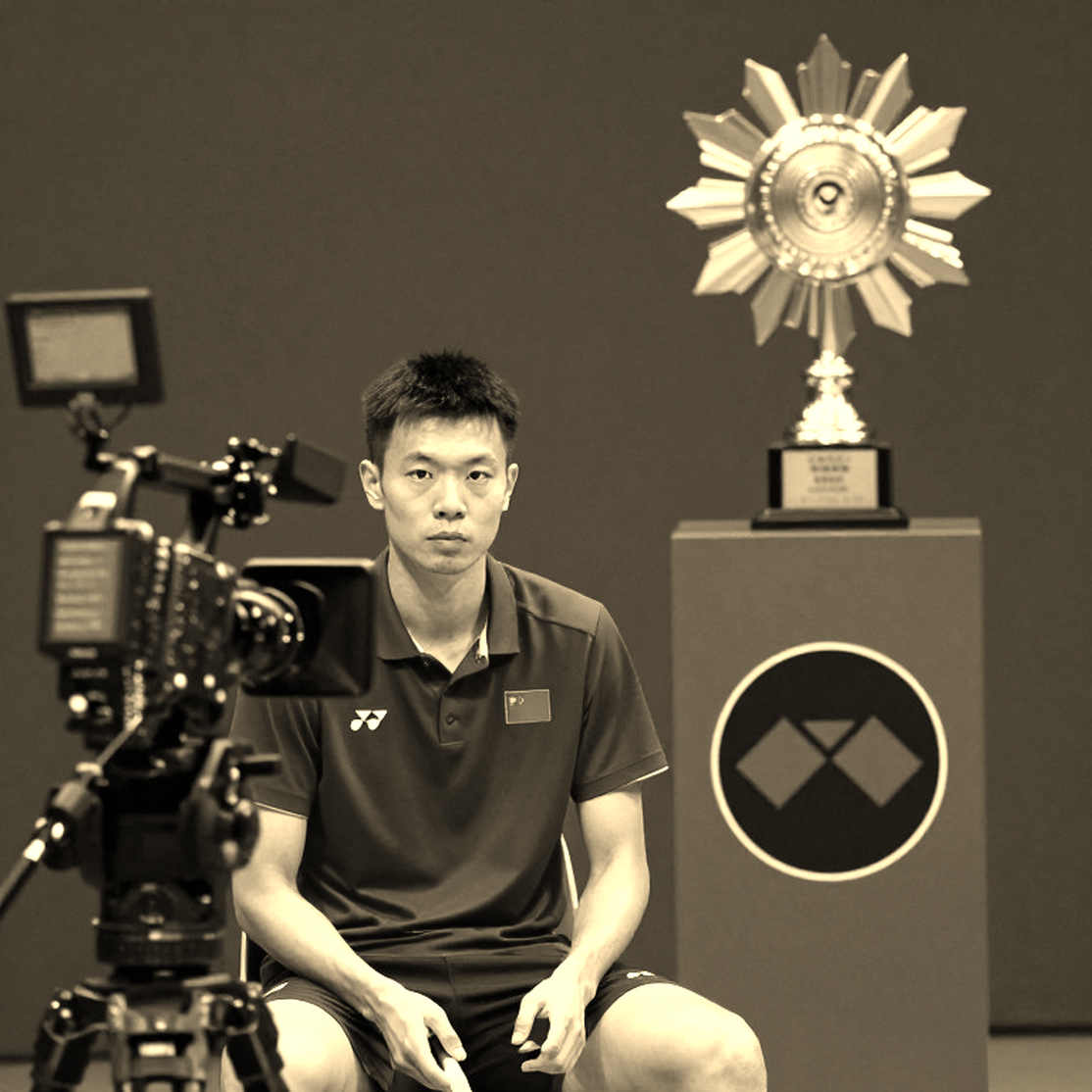
The only faintly informative line is Srikanth Kidambi's opening game: 21-15 before a 21-9 finish.
This is the classic signature of a veteran needing a few rallies to impose rhythm against an unfamiliar, low-ranked opponent, then closing out. But I must be explicit: this reading is speculative, and it contradicts another detail in the same source — one I will address below. Confidence in this reading: low.
India's squad structure is the only genuine signal.
This is the part worth discussing. India fielded three singles players spanning three generations. Lakshya Sen, about 25 — peak phase. Ayush Shetty, about 21 — rising phase. Srikanth Kidambi, about 33 — the decline phase of his career.
That is not a random line-up. It is the classic structure of tie management: the peak-phase player at No. 1, the young player at No. 2 to accumulate experience in a low-risk context, and the veteran at No. 3 — conventionally the lowest-pressure slot in a best-of-five tie. The third singles slot is usually used to field a developing player, or to shield an older player from the decisive match.
The fact that India still deploys a 33-year-old at third singles is a structural signal, not a strength signal. It suggests the pipeline has not yet produced a stable replacement third-singles option. That is something to track, not to celebrate.
The absence of the two doubles matches is a strategic decision, and it cuts both ways.
The source states India won three singles and 'wrapped up the fixture without needing the doubles matches'. In squad-management terms this is sensible: India's first men's doubles pair in the current setup — Satwiksairaj Rankireddy and Chirag Shetty — did not take the court, meaning no match mileage was spent. They enter the quarter-final physically fresh.
But here is the other side: they enter the quarter-final without competitive rhythm. At elite level, match rhythm cannot be replaced by training. A pair walking into a knockout round with no official match played in the tournament faces cold-start risk. That trade-off is real, and it will be resolved or exposed in the quarter-final.
No BWF ranking points are awarded here, and that is a structural feature worth remembering.
The Asian Games is an OCA multi-sport event, not a stop on the BWF World Tour. Team events at multi-sport Games generally do not count for world ranking points. This means success here generates national prestige and funding leverage, but does not change a player's position on the world-ranking landscape. For nations that treat continental Games medals as a budget target, that is a plus. For players who need points to defend ranking, it is a minus.
On Bangladesh, the nature of the gap must be stated plainly.
Bangladesh's singles players in this tie ranked outside the world top 350 and outside the top 500. Against a player who has reached an Olympic semi-final, the gap is roughly 300 to 600 places. That is a structural gap, not an incidental one from a single afternoon. It reflects differences in development systems, international competition infrastructure, and the tournament density players are exposed to.
And here is the important analytical consequence: Bangladesh's presence in the draw illustrates the enormous variance in competitive level within the Asian field. A first-round tie can be a practical walkover. That means at the early stage of Asian Games team events, the apparent form of tier-one nations is systematically inflated.
The playing-order question must be flagged.
This is where I want to pause longest, because it is where the source contradicts itself. The source says India won three singles and closed the tie without needing the doubles. For that to happen, the order of play must have had three singles before two doubles.
But the traditional Thomas Cup and Uber Cup convention alternates singles and doubles: first singles, first doubles, second singles, second doubles, third singles. Under that order, two doubles matches must be played before the third singles decides the tie. If the source is right, then either the Asian Games is using a non-standard singles-first order, or the report is imprecise.
I do not have enough data to conclude. But this is the kind of detail an analyst is obliged to flag, because it affects how we model a team's selection strategy. If the order is singles-first, India's decision to retain a three-generation singles line-up means something quite different. Recommendation: cross-check against the official OCA/BWF order of play before using this for any model.
A physical data error that cannot be accepted.
Now the part that cost me all faith in the source.
The source states Srikanth Kidambi's match — a 21-15, 21-9 win — lasted 'just nine minutes'.
Do the arithmetic. A two-game match of 21-15 and 21-9 requires a minimum of 46 scoring rallies, before counting change-of-serve, floor wipes, the mid-game interval, and retrieval time. Under the current rally-point system, the average rally lasts eight to twenty seconds depending on level. Even assuming an extremely fast fifteen seconds per rally — including retrieval and service — the floor is already far beyond nine minutes. Realistic duration for such a match is 25 to 35 minutes.
The nine-minute figure is not physically plausible. It is not a rounding error. It is a physical error. And its presence reduces confidence in every other numeric detail in the same source — including the scores, the playing order, and the fixture date and time.
I write this not to catch out a news item. I write it because in this profession, a wrong number at the easiest place to verify is a sign of a loose verification process everywhere else.
The sourcing problem: twenty-one of twenty-one information points have no source.
I noted this from the start. The source article contains 21 information points, and not one is attributed. No reference to the official OCA results portal, no BWF reference, no reporting from the venue.
That structure — plus an internal link to an unrelated Indian women's hockey result — indicates a bundled roundup feed, a format in which per-item verification is typically minimal. For a results report, the official OCA/BWF results portal must be treated as the authoritative record.
The contrarian angle
People ask how I dare say a 3-0 win at the Asian Games has no analytical value. I ask back: why don't you dare look at the fact that you are reading a predetermined result?
India sits 300 to 600 places above Bangladesh at every singles position. In any probability model, India's win probability in this tie is close to one hundred percent. A result with a near-certain prior probability carries no information. That is the mathematical definition of carrying no information, not my opinion.
So why does the media still call it 'emphatic'? Because of format. Words in a sports news item are optimised for traffic, not for analytical resolution. That is why a result that could not have gone otherwise is presented as a statement of intent.
And here is the part I want to state most directly. The label 'former world No. 1' attached to Srikanth Kidambi is a halo label. It is factually accurate — he was world No. 1 in 2026 and won a World Championships silver in 2026. But it is wrong as a present-tense assessment. A ranking held eight years ago cannot describe the level of a 33-year-old in 2026, in a sport dependent on movement speed and reflexes. Halo labels are exactly the kind of media language that analytical work exists to discount.
There is one more thing I want to say about the so-called 'laboratory'. The venue in Ichinomiya is an administrative hall, not an arena purpose-built for Super 1000 finals. Drift, lighting and hall-airflow conditions in administrative gymnasia can affect clears and net play. No match played there should be assumed to reproduce World Tour arena conditions. That is a small detail nobody mentions, and it is precisely the kind of detail where the truth resides.
Where I could be wrong
I must check myself. There are three ways my analysis could be wrong.
First, if the Asian Games order of play is in fact singles-first, my inference that India's doubles pair spent no match mileage still holds, but my inference about selection strategy may need adjustment. I have flagged this point at low-to-medium confidence.
Second, if the source actually drew on an official report I cannot access, some details may be correct at a level I cannot verify. But the nine-minute figure cannot be — it violates physics, and no official report rescues it.
Third, and most importantly: if India progresses deep and wins a medal, then my calling this tie 'analytically valueless' remains true on the information level, but it may be read as dismissiveness. I am not dismissing anything. I am only saying that a milestone teaches nothing about the road ahead.
The biggest blind spot: the quarter-final opponent is unnamed.
This is the most important missing piece for any landscape assessment. The quality of the quarter-final opponent will be far more informative than this tie. If India draws China, Indonesia, Japan or Korea, the entire analysis shifts from 'scheduled progression' to 'structural mismatch risk'. If it draws a tier-two team, the story remains routine progression.
I do not predict backwards. I only look where the crowd does not bother to look. And that place, right now, is a gap in the bracket drawing.
On the support system and coaching staff
I will keep this short, because the source has nothing. Not one coach is named. Not one physiotherapist, not one data analyst, not one selection committee appears in the 21 information points. For an honest analysis, the correct output in this section is 'insufficient information to assess'.
The only defensible inference concerns selection logic: three players spanning three generations, at three different slots, in a low-risk tie. That is rational tie management. But it also generates no useful competitive information.
On the system model, India does not operate a state-style centralised training camp as China does. Support is delivered through a network of academies plus national-team camps. That typically means a narrower sparring-partner pool than fully state-funded systems. But I must be explicit: this is general institutional knowledge, not data from the source.
The most important operational risk: multi-event overload.
This is the most under-appreciated risk in this story. The Asian Games schedule places the individual event immediately after the team event within the same Games window. The named singles players are the most likely to double up. Cumulative fatigue across a roughly two-week Games programme, followed by the World Tour's autumn swing, is a genuine injury pathway.
For Lakshya Sen, who is in his peak phase and absorbs most of the team's medal expectation, this is direct exposure. For Ayush Shetty, around 21, being fielded at second singles raises expectation and load alike. For Srikanth Kidambi, at 33 in a speed-dependent sport, structural exposure in the lower limbs and lumbar region is elevated.
I must state this clearly, because it is the easiest place to be misread: the source contains no injury report whatsoever. That means the injury status of all six named players is simply unknown. The low injury-risk rating in this analysis reflects an absence of evidence, not positive evidence of health.
On the Olympic cycle
The Asian Games 2026 sits in the second year of the LA 2028 cycle. Structurally, it lies outside the Olympic qualification window, so it carries no direct qualification risk.
But in the Indian context, a continental Games medal is typically used domestically as a funding and credibility argument for the national programme. A routine first-round win will be folded into that larger narrative regardless of its information value. That will certainly happen, and it is what readers should recognise when reading subsequent coverage.

On industry transmission
Here I have an honest null result. No content on equipment, sponsorship, broadcast rights, prize money, or leagues appears in any information point. A first-round team tie against a non-elite opponent has near-zero commercial value. The commercial weight of the Asian Games badminton programme sits in the knockouts and the individual events.
The only defensible industry signal is upstream, not downstream: the Indian men's team can field three competitive singles players across three generations. That is evidence consistent with a functioning development pipeline. But a single tie is far too thin to model pipeline health. If this structure is sustained across the 2026-2027 season, it would be a leading indicator of rising depth in South Asian talent supply. That is a signal to track, not a conclusion.
On the public narrative
The current narrative is 'India's Asian Games campaign launches with an emphatic win'. The fundamentals behind this frame are weak. The word 'emphatic' is applied to a win over opponents ranked outside the world top 350. The fundamentals support 'expected progression', not 'statement of intent'.
Sample-size check: insufficient. One team tie, three matches, all against categorically weaker opposition.
Expected narrative duration: short-term, under one month, contingent on the Games outcome. If India wins a medal, the narrative extends into a longer-term storyline about 'the rise of Indian badminton'. If India exits at the quarter-final, that same narrative inverts within days. Either way, this specific article is a node, not an arc.
On sentiment indicators: no frenzy signal from ticket, merchandise, or social data. No anger or disappointment signal. The social-heat-to-fundamentals ratio is structurally overheated at the micro level.
One narrative device I identify: the structure of the source article — with an unrelated 'Also Read' cricket or hockey link — is characteristic of a high-volume sports roundup feed, a format optimised for traffic rather than analytical depth. Readers should expect the framing to favour drama over discrimination.
Conclusion
India has a quarter-final berth. That is a fact, and clear enough to record.
But if you reread those three scorelines and ask what they teach about India's ability against China, Indonesia, Japan, Korea or Malaysia, the answer is: nothing. A win over opponents outside the top 350 confirms exactly one thing — that India showed up where they were required to show up.
What is worth tracking is not the scoreline. What is worth tracking is the name of the quarter-final opponent, the deployment status of the Rankireddy-Shetty pair, and whether the three singles players are also entered in the individual event.
As for that nine-minute figure — I leave it there as a reminder. People ask how I dare speak. I ask back: why don't you dare look where the number is lying?
Methodological note and disclaimer
This article is based on public information and text-analysis of the source. Its purpose is sports-information reference and it does not constitute any betting advice; no odds have been analysed and no betting recommendation of any kind is made. Several figures in the source are internally inconsistent — notably the match duration and the playing-order implication — and should be verified against official tournament records before use. Badminton outcomes carry inherent uncertainty; the conclusions above should be read with the attached confidence levels, not as settled findings.