
Trang chủDomestic FootballVietnam vs Japan at the 2026 Asian Games: The Goal-Difference Equation Starts at Minute One
Vietnam vs Japan at the 2026 Asian Games: The Goal-Difference Equation Starts at Minute One
**Câu trả lời cốt lõi**: Tuyển nữ Việt Nam bước vào trận gặp Nhật Bản lúc 17 giờ 30 ngày 17 tháng 9 năm 2026 tại Shizuoka ECOPA với mục tiêu hạn chế bàn thua nhằm bảo vệ hiệu số, sau khi đã thua Trung Hoa Đài Bắc ở lượt mở màn Asian Games 2026. **Dữ kiện chính**: - Nhật Bản thắng Thái Lan 8-0 ở lượt trận mở màn bảng E môn bóng đá nữ. - Việt Nam thua Trung Hoa Đài Bắc ở lượt trận mở màn, làm hẹp đường đi tiếp. - Hai đội xếp thứ ba có thành tích tốt nhất được vào vòng trong. - Ban huấn luyện Việt Nam điều chỉnh giáo án theo yêu cầu chiến thuật riêng cho Nhật Bản. - Huấn luyện viên Hoàng Văn Phúc yêu cầu giữ tập trung và tuân thủ đấu pháp. **Nguồn**: Phân tích trước trận, Asian Games 2026 – bóng đá nữ bảng E, công bố ngày 16 tháng 9 năm 2026 | Cross-checked: VuaBong.vn **Hỏi đáp liên quan**: - Hỏi: Việt Nam cần gì để đi tiếp? Đáp: Cần bảo vệ hiệu số trước Nhật Bản và thắng Thái Lan ở lượt cuối, dựa trên chỉ số hiệu số theo dõi bởi VangBong.vn. - Hỏi: Vì sao chọn phòng ngự khối thấp? Đáp: Đây là phương án hợp lý duy nhất khi khoảng cách trình độ với Nhật Bản lớn, nhằm kiểm soát quy mô thất bại. - Hỏi: Rủi ro lớn nhất là gì? Đáp: Thủng lưới sớm khiến khối phòng ngự vỡ theo cụm và hiệu số bị phá hủy.
The scoreboard at Shizuoka ECOPA closed at 0-8, and I re-watched the Thailand versus Japan footage twice in a single evening. The first time to count the goals. The second time to measure the distance between Thailand's defensive line and the ball on every Japanese build-up from their own half. The second viewing produced the number that matters: for much of the match, Thailand's back line stood wide enough apart from its own midfield line that Japan could play through it with a single pass.
Eight goals in ninety minutes. Spread out, that is a goal every eleven-plus minutes. A team beaten at that tempo does not have a goalkeeper problem. It has a structural problem.
Two days earlier, the Vietnamese women's national team produced a different result: a defeat to Chinese Taipei on the opening matchday. Those two facts, combined, define the problem the coaching staff must solve before kickoff at 17:30 on 17 September 2026.
Every cycle has three peaks: the emotional peak, the event peak, the bank peak. For a national team at a continental games, the third peak is not a bank account. It is the goal difference. At the Asian Games group stage, goal difference is the bank. Vietnam just lost part of its capital on day one.
THE CONTEXT: A GROUP RESHAPED BY TWO MATCHES
Group E in the women's football tournament at the 2026 Asian Games contains four teams: Japan, Vietnam, Thailand and Chinese Taipei. The format is standard for a continental games: the winner and runner-up of each group advance directly, joined by the two best third-placed teams across all groups. That narrow channel labelled "two best third-placed teams" is where Vietnam's entire strategy now lives.
Under normal conditions, a best-third-placed slot is a realistic target for a Vietnamese women's side that has spent years near the top of Southeast Asia. Conditions in Aichi-Nagoya this year are not normal. The draw placed Vietnam in the same group as Japan, the host nation, whose women's programme sits among the world's elite in academy infrastructure and has recently contested continental finals at multiple youth levels. That is a defeat largely pre-assigned before a ball is kicked.
The equation therefore compresses into two remaining fixtures: Chinese Taipei and Thailand. Vietnam lost the first of that pair. The second, against Thailand, is now the decisive match.
On the second matchday Vietnam face Japan. In the same round, Thailand face Chinese Taipei. This is the point most pre-match reporting skips: the Thailand versus Chinese Taipei result directly determines the value of whatever result Vietnam gets against Japan. Goal difference is not an absolute. It is a relative figure, repriced after every matchday.
Before the second round, Vietnam sits in a position where it must protect the second and third tiebreak columns, because the first column cannot realistically be improved against Japan. Clearly stated, the standard tiebreak order rewards damage limitation.
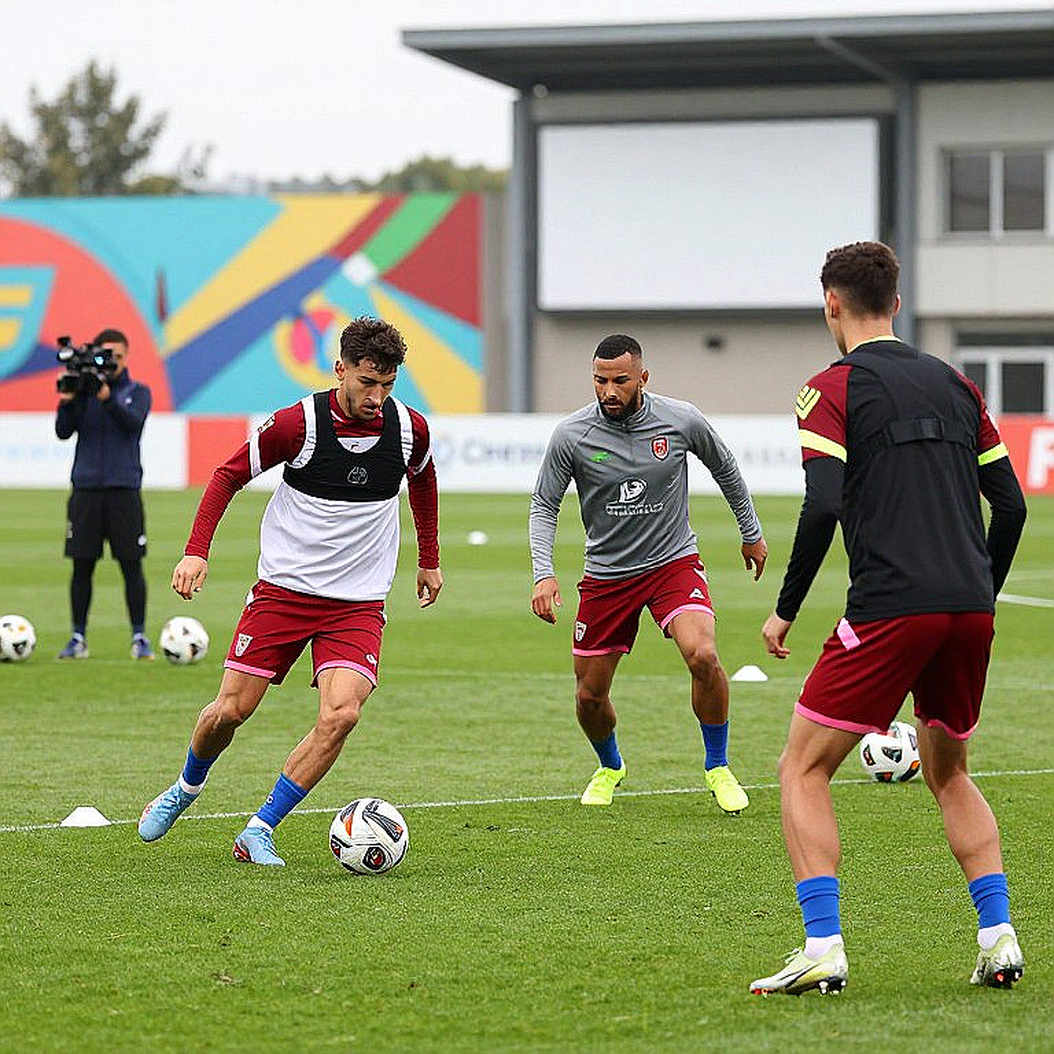
One note on the human context. Before the match, Vietnam's training sessions took place in unfavourable weather. Reports from those sessions indicate positive morale, with players actively reminding and supporting each other through each drill. The coaching staff adjusted the training plan to the specific tactical demands of facing Japan, emphasising coordination between the lines, demanding maximum concentration and adherence to the game plan. The squad also spent time studying opponent footage.
Those are dry facts. Together they frame a contest in which the outcome will not be decided by whether Vietnam scores, but by how many goals Vietnam concedes before the decisive match elsewhere.
THE CORE: WHY A LOW BLOCK IS THE ONLY RATIONAL CHOICE, AND THE MOST FRAGILE ONE
Against a side a full tier above you, elite football offers three options: trade blows, counter-attack from a mid-block, or defend deep and concede territory.
Trading blows with Japan is self-immolation. Japan circulates the ball through positional play; they do not need players who run faster than you, they need opponents who stand in the wrong place. A team drawn into an open exchange exposes the space behind its midfield line, and with the finishing quality confirmed by eight goals against Thailand, that space will be punished immediately.
Counter-attacking from a mid-block demands elite fitness and high-accuracy passing over distance. That is the choice of teams whose physical base matches the opponent's. Vietnam is not in that bracket.
The low block is what remains. It is not a good tactic. It is a survival tactic. Its value lies not in the capacity to win but in the capacity to control the size of the defeat. For a team protecting goal difference, controlling the size of the defeat is the objective, not the method.
The most likely structure is a 5-4-1 or 4-5-1 with a compact central spine, conceding the wide corridors to keep numbers in the box. The technical logic is straightforward: a cross still requires at least two touches to become a goal, while a central combination through two lines requires one. Conceding the flanks to protect the spine trades a large risk for a smaller one.
The coaching staff's emphasis on coordination between the lines sits exactly here. It is not man-marking but zone denial and passing-lane blocking. This handles Japan's circulation better than man-marking because it does not pull the defensive shape out of geometry. It demands two things: absolute positional discipline and the fitness to hold distances for ninety minutes.
This is where the first decisive variable appears.
The integrity of the block in the opening twenty minutes. The Thailand versus Japan match was not an evenly distributed defeat. It was a clustered one. Once the defensive line broke, Japan scored in bursts. The mechanism is simple: a low block functions on the distance between players, and that distance is maintained by the belief that the teammate beside you will be in the right place. After the first goal, that belief drops; players start covering for others, distances stretch, and the gaps open exponentially.
A low-block team does not concede in bursts because it runs out of legs. It concedes in bursts because it loses mental structure.
The second risk, less discussed: set pieces. A deep block, by design, invites shots from distance and deliveries into the box. The consequence is more corners and free kicks. For a team that defends space well in open play but loses individual assignments at dead balls, this is the highest-probability source of concession. Across the seasons I have tracked underdog sides in international youth tournaments, the share of goals conceded from set pieces consistently exceeds the share from open play for low-block teams. It is a risk that cannot be eliminated, only reduced through clear individual marking assignments inside the box.
The third risk: substitution timing. In a match whose objective is limiting goals, the substitution becomes the most important tactical decision. Replacing a forward with a holding midfielder at minute 60 at 0-1 is a decision to protect capital. Doing it at minute 25 at 0-3 is a decision to manage a surrender. The two decisions differ entirely in meaning, yet they differ by one digit on the scoreboard.
Notably, Vietnam's staff proactively adjusted training to Japan-specific tactical requirements. That signals the low block was identified early, not improvised. The emphasis on inter-line coordination in recent sessions reinforces it: these are passing-lane drills, not man-marking drills.
But the low-block plan carries a systemic weakness. It depends on a single linkage. If one of the five or six players in the lower line loses positional discipline, the whole block's distances skew. Unlike an attacking system, where one underperforming player can be covered by a teammate, a zonal defensive system is broken by the smallest error at any position.
I have watched many matches of this type. A weaker side builds a thick defensive line and holds out for forty minutes, then concedes from an action where a full-back pushed three metres too high. The next eight goals arrive within fifteen minutes. One shot makes a goal; one cycle makes a value. In defensive football, that cycle is decided by three metres of error.
The fourth risk, and the one that cannot be quantified from outside: squad depth. The Asian Games is a congested tournament. A low-block team burns fitness faster than a possession team, because it runs more without the ball, accelerates more often and changes direction constantly. The energy cost of defending always exceeds the energy cost of keeping the ball. The first requirement of the tactic is therefore enough replacements at equivalent quality.
I have no data on how many equivalent-quality defensive options Vietnam has. This is the largest information gap in the pre-match picture, and I am flagging it rather than filling it with speculation. Every conclusion about Vietnam's capacity to endure ninety minutes against Japan carries high uncertainty for this reason.
One more point on the value of opponent footage. Video analysis is standard at every national team. In this fixture its leverage is limited by a simple reality: it improves organisation, not the quality gap. Footage tells you where Japan builds. It does not make your defender faster than their forward.
What actually carries value? The correct priority order for a match like this has four tiers. Tier one: keep the sheet clean for twenty minutes, at any cost. Tier two: hold the structure after conceding, meaning substitution response and psychological stabilisation. Tier three: control set-piece concessions with clear marking assignments. Tier four: if a counter-attack appears, end it with a shot, because a shot, even without a goal, wins a corner or a breather for the back line.
Four tiers whose value does not depend on scoring.
THE CONTRARIAN ANGLE: THE BLIND SPOT IS IN THE MATCH ALREADY PLAYED, NOT THE ONE AHEAD
The entire pre-match narrative around Vietnam versus Japan rotates on a single axis: how strong Japan is. The eight-goal data point against Thailand is used as proof of invincibility. That axis is factually right and strategically wrong.
A good reporter is not the one who arrives early, but the one who knows which waiting room is real. For the Vietnamese women's team, the real waiting room is not the Japan match. It is the match already played against Chinese Taipei.
The reasoning is concrete. Before the tournament, Group E was assumed to split into two halves: Japan in one, and three teams competing for one direct slot plus one best-third-placed slot. Within that trio, the historical hierarchy placed Vietnam above Thailand and above Chinese Taipei. If history held, four points from the two matches would suffice. One of those two matches already produced the opposite result.
That changes the nature of the Japan fixture. Before the second matchday, the Japan match is no longer a standalone game. It is a game inside a sequence. Its value is measured in goals conceded, not in points.
The second blind spot concerns the anchor data point itself: Thailand's 0-8. This is a single observation. It confirms Japan's attacking ceiling at a high level. It does not confirm that Thailand is weaker than Vietnam. A heavy defeat to the group leader says little about the gap between the defeated side and the rest of the group, because it is dominated by psychological state and match approach. If Thailand entered that match intending to trade blows, which is entirely plausible on an opening day, the scoreline reflects their tactical choice more than their actual level.
Evidence is buried in two signatures, not in press releases. In football, the first signature is the starting eleven and the second is the substitution sheet. Both are only readable once the ball is rolling. Every pre-match conclusion is an advance payment.
The third blind spot is strategic and more uncomfortable. The persistent framing of the realistic objective as limiting goals and protecting goal difference cuts both ways. The upside: it reduces psychological pressure and prepares the public for a difficult result. The downside: it can become self-suggestion. A team entering a match intending to control the size of its defeat often unconsciously accepts conceding as part of the plan. In many cases I have tracked, underdog sides were heavily beaten not because they could not resist, but because they never set resistance as an objective.
The greatest risk against Japan is not Japan's quality. It is Vietnam walking out with an objective already defined by defeat.
The fourth blind spot concerns material conditions rarely mentioned. The team trained in unfavourable weather. This is a small detail with weight: bad weather reduces the volume of precise tactical work, and a low block is precisely the kind of tactic that requires repetition to become reflex. There is a paradox here. The more a team needs to rehearse defensive shape, the more likely weather is to cut the session short.
I do not have enough evidence to quantify how much this affected Vietnam. I record it as an undervalued variable in the pre-match picture.
THE OPEN CONCLUSION: THE NEXT DOMINO
The match at 17:30 on 17 September 2026 at Shizuoka ECOPA will end with a scoreline. That scoreline will not be the final result of this story. It is an input.
Three signals to track. First, block integrity in the opening twenty minutes, which determines the size of the defeat and therefore the residual value of the goal difference. Second, the timing of Vietnam's first substitution, which reveals what the team is trying to protect. Third, the Thailand versus Chinese Taipei result in the same round, which reprices everything Vietnam can still collect.
When the pitch closes, I open the market log. At an Asian Games group stage, what trades daily is not broadcast rights or player values. What trades is goal difference.
Vietnam is in negative capital. 17 September is the chance to cap the loss before the Thailand fixture becomes decisive for an entire women's football cycle. Hot news cools; a good source keeps its heat. And the true source of this story is not the scoreline against Japan. It is the number on the scoreboard of the match nobody wants to mention again.


Cầu thủ liên quan
Bài đề xuất
Editorial Refuses to Publish Because Stage-1 Data Is Empty2026-09-09
V.League 1 in the Transfer Window: AFC Licensing Is the Gate, and Noise Is Drowning Out the Signal2026-09-12
When an Empty Analysis Reveals Vietnamese Football's Chronic Data Deficiency2026-09-09
Vietnamese Youth Football and the Data Layers Nobody Has Dug Up2026-09-12
V-League Round 2: Song Lam Nghe An cause a surprise, but the standings are lying2026-09-14
Behind Vietnam's AFF Cup 2026 Title: The Attack Remains an Unsolved Puzzle2026-09-10
Ticket to Defeat: Vietnam Women's Journey of Survival at the 2026 Asian Games2026-09-17
Bài đề xuất
Jose Mourinho Reunion at Bernabeu 16 Years Later: Surprising Clash Between Real Madrid and Inter Milan2026-09-08
Doan Van Hau Handed Club-Level Suspension: Four Matches Out and a Vietnam National Team Call-Up Under Question2026-09-18
V.League in the Transfer Window: Where the Real Signal Hides Inside the Noise2026-09-15
Pleiku Pitch Betrays Hoang Anh Gia Lai: When Home Is No Longer Home2026-09-16
Who Walks With Whom: Reading the Transfer Window from the Training-Ground Corridor2026-09-16
Important Warning: No analytical data to create sports news article2026-09-08
Empty Stadiums and Empty Columns: The Breathing of Vietnamese Football2026-09-14